EchoGrasp
View on GitHub →
INTEL · OPENVINO SPEECHMATICS PYBULLET

A robot that knows when
it didn't work.

A voice-directed bimanual robot-arm system that plans with an LLM, acts in simulation, verifies its own results with a real Intel OpenVINO vision model — and when it fails, says so honestly and fixes itself.

Every demo shows a robot that works.

We built one that shows what happens when it doesn't.

The Problem

Physical-AI demos are everywhere right now, and bimanual manipulation is the obvious "hot" category. That means a crowded field of lookalikes: "say a command, watch an arm move." Most of them optimize for exactly one thing — looking like it worked.

The Insight

"In real factories and warehouses, the expensive failures aren't the obvious ones — they're the silent ones a system doesn't know it made."

EchoGrasp optimizes for the inversion: not "look, it worked" — but "look, it knows when it didn't, and fixes it."

Architecture

Three real infrastructure services — speech, planning, vision — wired through an orchestrator that has to handle partial failure gracefully.

MIC
Browser audio
→
STT
Speechmatics
real-time
→
LLM
Groq task
planner
→
SIM
PyBullet
dual-arm
→
CV
OpenVINO
INT8 verify
→
UI
Honesty
Dashboard
The closed loop: when OpenVINO + the simulator's ground-truth position check disagree with the intended outcome, the failure reason streams to the dashboard live in plain language, and the orchestrator re-plans the SIM step with a corrected approach — widened grasp tolerance, adjusted offset — up to a bounded number of retries, before honestly reporting a final result.

This is a real run — not staged footage of a staged result

Step 1's grasp genuinely misses. The system says so in plain language, re-plans, retries, and succeeds. Every confidence number on screen is a real OpenVINO INT8 inference result, and the pass/fail call is confirmed against the simulator's own physics state.
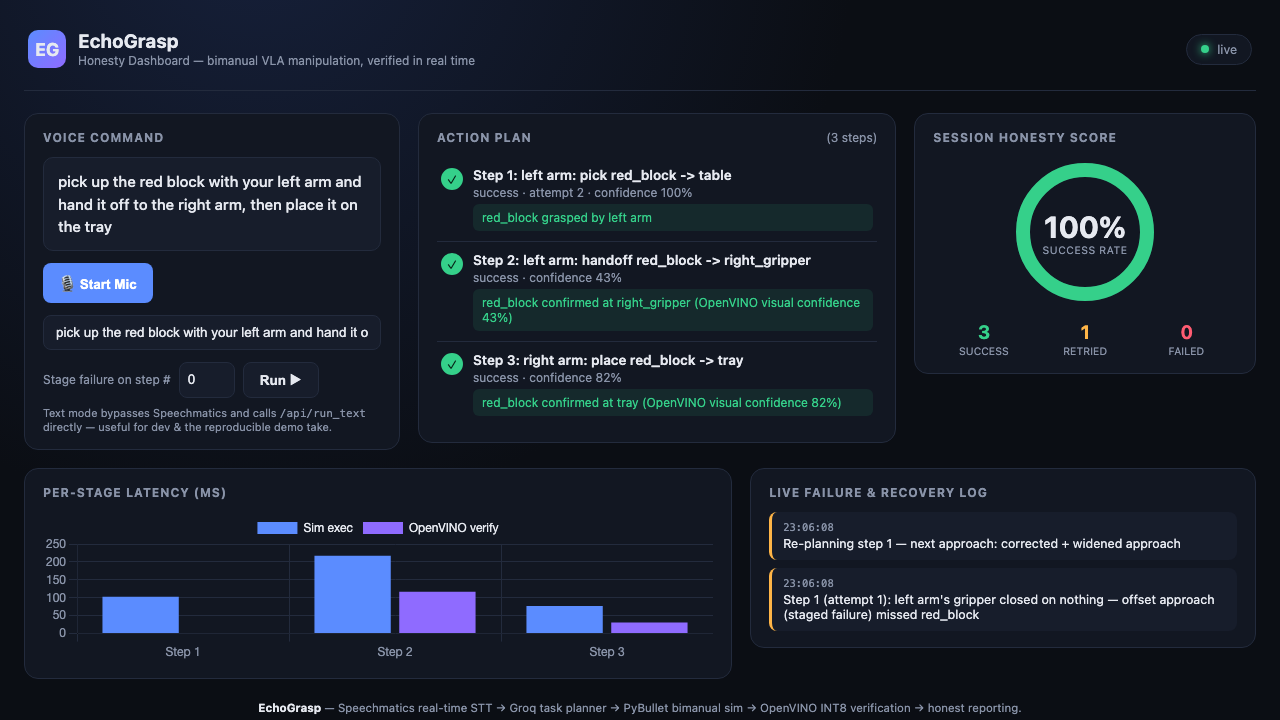
EchoGrasp Honesty Dashboard mid-demo: a staged grasp failure, a corrected retry, a successful handoff, and a 100% session honesty score

Captured live from the running dashboard: staged failure on step 1 → plain-language reason → corrected retry → successful handoff → successful placement → 100% session score.

Honest numbers

We'd rather tell you the real accuracy of our own verification model than oversell it — that felt like the point of the whole project.

100%
session honesty score
in the demo run shown above
3
real bugs found & fixed
via live end-to-end testing
60–70%
OpenVINO model accuracy
reported honestly, not oversold
2
bounded retry attempts
before an honest final failure

Try it yourself

This page is a static project showcase — GitHub Pages can't run Python, physics simulation, or AI inference. The actual app is a real local server. It takes about two minutes to get running.

git clone https://github.com/JoysonJoe20/InfraSummit.git
cd InfraSummit
python -m venv .venv && source .venv/bin/activate
pip install -r requirements.txt
cp .env.example .env   # add your SPEECHMATICS_API_KEY and GROQ_API_KEY

python -m backend.verify.train_or_prepare_model   # one-time: trains the OpenVINO verifier
python -m backend.verify.export_openvino

./scripts/run_demo.sh   # opens http://localhost:8000
Why this can't just be a link: EchoGrasp runs a live PyBullet physics simulation, a FastAPI + WebSocket backend, and real OpenVINO INT8 inference on every step. A static site literally cannot execute any of that — it needs a real Python process running on a real machine, which is exactly what the two-minute setup above gives you.